Hair Maxxing: The Complete Guide to Hair Growth and Density
Hair is the most visible marker of youth and health. Hair loss in your 20s or 30s is solvable if you act early. This guide covers the biology, prevention, and optimization strategies that actually work — including the DHT paradox that makes the same hormone thicken your beard while thinning your scalp.
Hair Biology 101
Hair growth cycle:
- Anagen (growth): 2–7 years. Hair actively grows.
- Catagen (transition): 2–3 weeks. Hair stops growing.
- Telogen (resting): 2–3 months. Hair doesn't grow; eventually sheds.
At any time, ~85% of your hair is in anagen, ~15% in telogen. Shedding 50–100 hairs per day is normal. Losing 200+ per day consistently can indicate a problem.
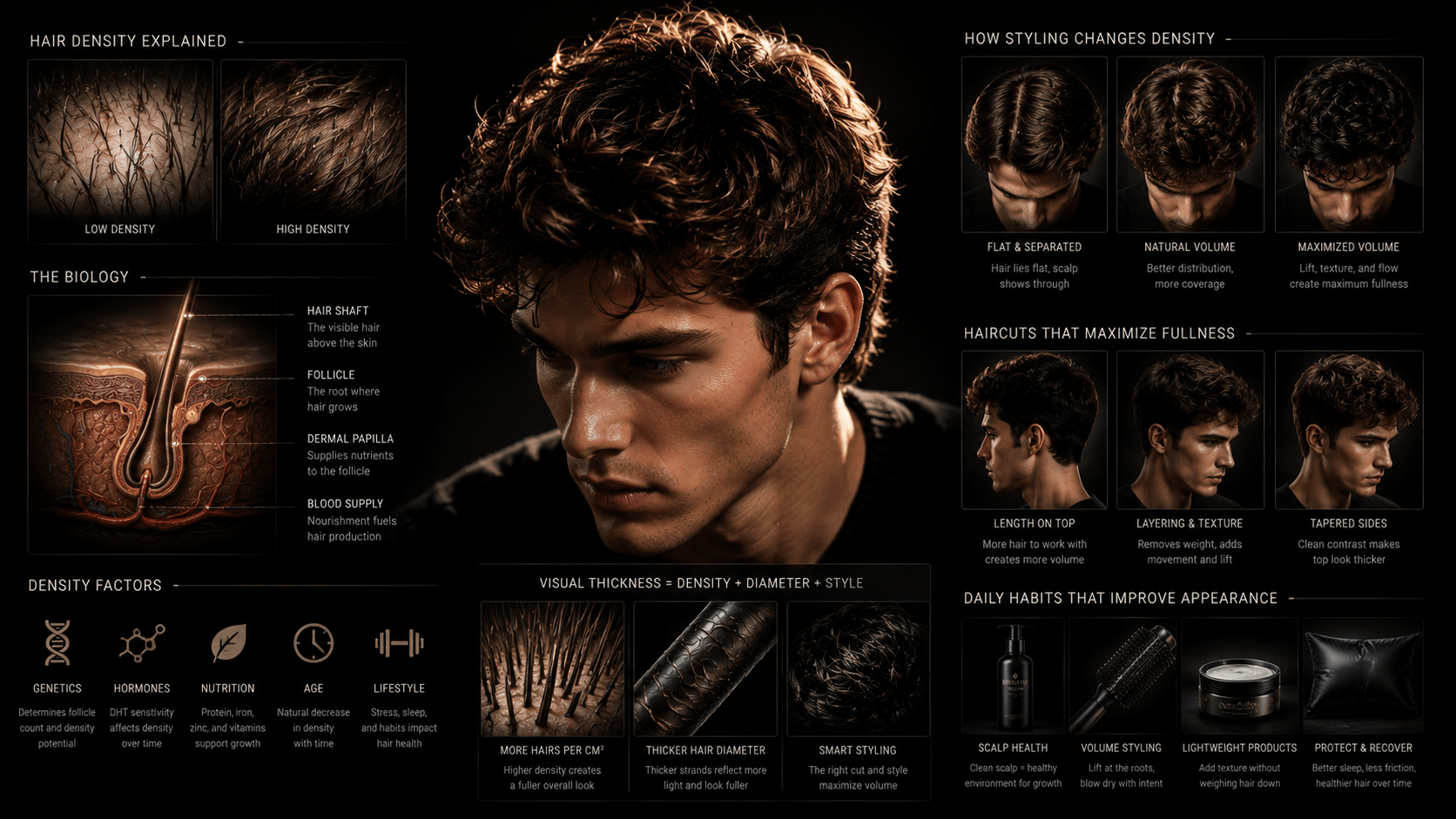
Hair thickness depends on:
- Follicle size (largely genetic, but can be improved)
- Hair shaft diameter (minor genetics, major nutrition)
- Growth phase duration (extended anagen = thicker hair)
Hair Loss: Why It Happens
Androgenetic Alopecia (Male/Female Pattern Hair Loss)
The mechanism: Genetics + DHT (dihydrotestosterone, a potent androgen) → follicle miniaturization. In genetically susceptible follicles, DHT binds the androgen receptor and progressively shrinks the follicle, shortening the anagen phase so hairs grow thinner, shorter, and lighter until they stop producing visible hair.12
Timeline: Starts slow (thinning on the crown or temples), accelerates over years.
Reversibility: Early-stage loss (roughly the first 1–3 years) responds best to treatment. Long-standing loss (10+ years) is partially reversible at best because miniaturized follicles eventually become dormant.
Other Causes of Hair Loss
- Stress (Telogen Effluvium): Prolonged stress or a shock (illness, surgery, crash diet) triggers premature shedding. Usually reversible once the trigger resolves.
- Nutritional deficiency: Iron, vitamin D, zinc, or B12 deficiency can cause shedding. Get labs if you suspect this.
- Thyroid dysfunction: Hypothyroidism causes diffuse shedding. Reversible with treatment.
- Medications: Some drugs trigger shedding; minoxidil and finasteride can cause temporary shedding when you start them.
Action: If shedding suddenly increases, see a doctor and rule out thyroid and deficiency before assuming genetics.
The DHT Paradox: Why Beards Grow While Scalp Hair Falls
DHT is roughly 3–5x more potent at the androgen receptor than testosterone, and it's produced when the enzyme 5-alpha reductase converts testosterone to DHT in the skin, prostate, and hair follicles. The confusing part is that DHT has opposite effects on different follicles:
- Scalp follicles (genetically susceptible): DHT drives miniaturization → thinning and loss.12
- Beard and body-hair follicles: DHT stimulates growth → thicker, denser, darker hair.
This is why the same man can grow an impressive beard while losing hair on top, why beard growth surges during puberty (when androgens rise), and why the two traits often track together in high-androgen individuals. The deciding factor for scalp loss isn't just how much DHT you have — it's how sensitive your scalp follicles are, which is set by androgen-receptor genetics you can't change.
The Finasteride Trade-off (beard vs. scalp)
Finasteride and dutasteride are 5-alpha reductase inhibitors — they lower DHT, which protects scalp follicles.12 Because DHT also fuels beard growth, aggressive DHT reduction can slow or slightly thin an existing beard for some users. That creates a genuine decision for men who are both losing hair and want maximum beard density:
- Prioritize scalp hair: Use finasteride (and/or minoxidil). Accept that beard growth may plateau.
- Prioritize beard: Skip systemic DHT blockers and rely on minoxidil (which works locally without lowering DHT), accepting faster scalp progression.
- Middle ground: Some clinicians use topical finasteride, which can reduce scalp DHT with less systemic exposure than oral dosing in some studies — potentially preserving more beard growth. Evidence is growing but still smaller than for oral finasteride.2
There's no universally "correct" choice here — it depends on how advanced your loss is, how much you value your beard, and your tolerance for side effects. This is exactly the kind of trade-off to discuss with a dermatologist rather than self-prescribe.
Prevention and Early Intervention
The single most important variable is timing. The earlier you intervene after noticing loss, the more you preserve. Miniaturization is far easier to slow than to reverse.
Minoxidil (Rogaine) — The Foundation
Minoxidil is FDA-approved and works locally by prolonging the anagen phase and increasing follicular blood flow. In network meta-analyses of male pattern hair loss, topical minoxidil 5% is the most effective topical monotherapy, while oral finasteride is the most effective oral monotherapy.2
Typical use (per product labeling / clinician guidance):
- Strength: 5% is standard for men; 2% is weaker.
- Frequency: Usually twice daily to the scalp.
- Expected result: Early visible improvement around 3–4 months; clearer regrowth by 6 months.
- Shedding phase (first few weeks): Temporary increased shedding as weak hairs are pushed out — usually a normal early sign, not a reason to quit.
- Maintenance: Gains reverse if you stop. It's a maintenance treatment, not a cure.
Finasteride (Propecia) — Systemic DHT Reduction
Finasteride blocks type II 5-alpha reductase, lowering serum and scalp DHT in a dose-dependent way, which slows miniaturization at its hormonal source.12 It's prescription-only and among the most effective options for male AGA.
What the evidence shows:
- Oral finasteride is the most effective oral monotherapy in comparative analyses.2
- Combination therapy (minoxidil + finasteride) outperforms either alone in meta-analyses, which is why many clinicians use both.2
Side effects (uncommon but real): A minority of users report sexual side effects (reduced libido or erectile changes); most resolve on stopping. Other effects are rarer. Because responses vary and finasteride is contraindicated in some situations (e.g., pregnancy exposure risk to a male fetus), this is a clinician conversation — not a self-managed decision.
Dermarolling (Microneedling for Hair)
Microneedling the scalp triggers a wound-healing response (growth factors such as VEGF and IGF-1) that can modestly boost density, especially when combined with minoxidil.
Typical approach: ~1.5mm roller, once or twice weekly (not daily — skin needs to heal). Apply minoxidil several hours after rolling, not onto fresh micro-wounds, to avoid excessive absorption and irritation.
Nutrition for Hair Health
Hair is keratin plus micronutrients; deficiency directly causes shedding. Supplementing beyond correcting a deficiency rarely helps.
- Protein: ~0.7–1g per lb bodyweight. Deficiency = weak, thin hair.
- Iron: A common cause of diffuse shedding in menstruating women and some vegetarians. Check ferritin if shedding is diffuse.
- Zinc: Deficiency causes shedding; excess is toxic — don't mega-dose without labs.
- Vitamin D: Low levels correlate with AGA and telogen effluvium; aim for a normal serum range.
- B12/folate: Vegans should supplement B12.
If you eat meat, eggs, legumes, and leafy greens, you likely cover these already. "Hair supplements" (Nutrafol, Viviscal, etc.) have modest evidence and aren't harmful, but they're optional.
Advanced Strategies (Optional)
- Scalp massage: May modestly improve thickness over months; free.
- Low-Level Laser Therapy (LLLT): FDA-cleared devices exist; evidence is weak-to-moderate and weaker than minoxidil/finasteride.
- PRP / stem-cell: Trendy, expensive, and evidence is still limited and variable.
- Hair transplant: Permanent but surgical and costly ($8k–15k+); best reserved for after medical options are exhausted, and only once loss has stabilized.
Hair Loss Timeline and Expectations
| Timeline | Minoxidil + Finasteride | Minoxidil Only | Finasteride Only |
|---|---|---|---|
| 3 months | Shedding phase ends | Shedding phase ends | Progression slows |
| 6 months | Visible regrowth | Modest improvement | Early stabilization |
| 12 months | Best regrowth of the three | Modest regrowth | Good stabilization + some regrowth |
| 2+ years | Sustained improvement | Plateau | Steady maintenance |
Individual response varies widely. These reflect general patterns from comparative studies, not guarantees.2
Building Your Hair Maxxing Plan
Tier 1 (start here): Minoxidil 5% twice daily · book a dermatology visit to discuss finasteride · fix obvious nutrition/deficiency gaps.
Tier 2 (after ~3 months, with clinician guidance): Add finasteride if appropriate · add dermarolling 1–2x weekly.
Tier 3 (6+ months, if still progressing): Discuss LLLT, topical finasteride, or a transplant consult once loss is stable.
Frequently Asked Questions
Does DHT cause all hair loss? No. DHT drives androgenetic alopecia in genetically susceptible follicles. Stress shedding, thyroid issues, and nutrient deficiencies are separate causes — which is why sudden shedding warrants labs before you assume genetics.1
Will blocking DHT ruin my gains or my beard? DHT reduction can slow beard growth for some users and is sometimes blamed for reduced libido, but muscle "gains" are driven more by testosterone than DHT. Effects vary; discuss the trade-offs with a clinician.
Is minoxidil or finasteride better? They work differently. Oral finasteride is the strongest oral monotherapy and topical minoxidil 5% the strongest topical monotherapy — but the combination beats either alone in meta-analyses.2
How long until I see results? Plan on 3–4 months for early signs and 6–12 months to judge real results. Anything faster is usually shedding dynamics, not regrowth.
Do I have to use it forever? For androgenetic alopecia, yes — stopping reverses the gains over the following months, because the underlying genetic sensitivity doesn't go away.
Final Word
Hair loss isn't your fault, but treatment is your responsibility — and the biggest lever is starting early. Minoxidil plus finasteride (with dermarolling as an add-on) is the evidence-backed core, and the two together outperform either alone. Understand the DHT paradox before you touch a 5-alpha reductase inhibitor, get labs if shedding is sudden, and make the prescription decisions with a clinician rather than a forum.
References
Footnotes
-
Comparative Effect of Conventional and Non-Conventional Over-the-Counter Treatments for Male Androgenetic Alopecia: A Systematic Review and Network Meta-Analysis. Int J Mol Sci. 2025;26(16):7920. (Mechanism of DHT-driven follicle miniaturization via 5-alpha reductase and the androgen receptor.) https://www.mdpi.com/1422-0067/26/16/7920 ↩ ↩2 ↩3 ↩4 ↩5
-
Gupta AK, Venkataraman M, Talukder M, Bamimore MA. Relative efficacy of minoxidil and the 5-α-reductase inhibitors in androgenetic alopecia treatment of male patients: a network meta-analysis. JAMA Dermatol. 2022;158(3):266–274. See also the 2025 network meta-analysis confirming topical minoxidil 5% as the leading topical and finasteride 1mg as the leading oral monotherapy. https://pmc.ncbi.nlm.nih.gov/articles/PMC12207719/ ↩ ↩2 ↩3 ↩4 ↩5 ↩6 ↩7 ↩8 ↩9 ↩10